0 items in your cart


Composers
- Katherine Balch
- Marcos Balter
- Robert Beaser
- Gavin Bryars
- Richard Carrick
- Christopher Cerrone
- Anthony Cheung
- Ann Cleare
- Douglas J. Cuomo
- Anthony Davis
- James Díaz
- Mario Diaz de Leon
- Joe Duddell
- John Duffy
- David Felder
- David Brynjar Franzson
- Beat Furrer
- Erin Gee
- Annie Gosfield
- Michael Hersch
- Lee Hoiby
- Katherine Hoover
- Kamran Ince
- Vijay Iyer
- Pierre Jalbert
- Gabriel Jenks
- Daniel Kidane
- Phil Kline
- Adrian Knight
- Mary Kouyoumdjian
- Joan La Barbara
- Fred Lerdahl
- Lei Liang
- Wang Lu
- Keeril Makan
- Steve Martland
- Alex Mincek
- Andrew Norman
- Stephen Paulus
- George Perle
- Tobias Picker
- Matthias Pintscher
- Bernard Rands
- Katharina Rosenberger
- Huang Ruo
- Joseph Schwantner
- Howard Shore
- Wayne Shorter
- Alvin Singleton
- Stanislaw Skrowaczewski
- Elijah Daniel Smith
- Kate Soper
- Gregory Spears
- Morton Subotnick
- Dobrinka Tabakova
- Karen Tanaka
- Ken Ueno
- Stewart Wallace
- Shelley Washington
- Kurt Weill
- Scott Wollschleger
- Katherine Young
- Ellen Taaffe Zwilich
Blog Archive
202420232022202120202019- ▼September (1 posts)
- ▼July (3 posts)
- ▼June (2 posts)
- ▼May (2 posts)
- ▼March (1 posts)
- ▼February (1 posts)
- ▼January (2 posts)
- ▼December (2 posts)
- ▼November (2 posts)
- ▼October (2 posts)
- ▼September (2 posts)
- ▼June (1 posts)
- ▼May (2 posts)
- ▼April (2 posts)
- ▼March (2 posts)
- ▼January (1 posts)
- ▼December (2 posts)
- ▼November (2 posts)
- ▼October (3 posts)
- ▼September (2 posts)
- ▼July (1 posts)
- ▼June (3 posts)
- ▼May (4 posts)
- ▼April (4 posts)
- ▼March (5 posts)
- ▼February
(11 posts)
- Alvin Singleton's "Sweet Chariot" at the National Museum of African American History & Culture
- Joan La Barbara Performs "Music for Merce" in Minneapolis & Chicago
- Praise for Kate Soper's "Ipsa Dixit"
- Æolus Quartet Performs Keeril Makan's "Washed by Fire"
- Mario Diaz de Leon Premieres "Sacrament" with Talea Ensemble
- Ann Cleare's "eyam v (woven)" Premieres at RTÉ National Symphony Orchestra
- Music from Copand House: Pierre Jalbert, "Secret Alchemy"
- Kettle Corn New Music Presents Scott Wollschleger's "Brontal Symmetry"
- Third Coast Percussion Premieres Christopher Cerrone's "Goldbeater's Skin"
- Anthony Cheung in Residency at 113 Composers Collective
- Kate Soper's "Ipsa Dixit" Premieres at Dixon Place
- ▼January (4 posts)
- ▼December (4 posts)
- ▼November (6 posts)
- ▼October
(5 posts)
- Andrew Norman's "Play", Revised & Ready for Action at the LA Phil
- Ann Cleare's "eyam ii" Premiered by Argento Ensemble
- Contemporary Piano Video Library features Lei Liang's "Garden Eight"
- Ted Hearne's "The Source" in Los Angeles and San Francisco
- Ethan Iverson interviews Alvin Singleton on "Do The Math"
- ▼September
(6 posts)
- New Works by Kate Soper and Mario Diaz de Leon at the LA Phil
- Lerdahl and Carrick Performed by Sound Icon in Boston
- Yale Choral Artists Perform Hannah Lash's "Requiem"
- Ann Cleare's "Mire |...| Veins" at the Festival of New Trumpet Music
- Ted Hearne: Sounds from the Bench
- Erin Gee Featured at the Resonant Bodies Festival
- ▼August (1 posts)
- ▼July (6 posts)
- ▼June
(6 posts)
- Lei Liang: Deriving Worlds
- Pierre Jalbert's "Howl" Recorded by Pro Arte Quartet
- Gregory Spears' "Fellow Travelers" Premieres at Cincinnati Opera
- New Releases of Morton Subotnick's Works for "Ghost Electronics"
- Timo Andres' "Comfort Food" in New York
- Anthony Cheung's "Dystemporal" Now Available from Wergo
- ▼May
(8 posts)
- Hannah Lash at the New York Philharmonic Biennial
- Jennifer Koh's "Shared Madness"
- World Premiere of Mario Diaz de Leon's "O Ignis Spiritus" by the TAK Ensemble
- Hannah Lash's "Beowulf" Premiered by Guerilla Opera
- Josh Modney in the PSNY Greenroom
- Alex Mincek: "On The Outside, Looking Out"
- Awards Season for PSNY Composers
- Upcoming Performances of Wollschleger, Cerrone
- ▼April (4 posts)
- ▼March (6 posts)
- ▼February
(6 posts)
- Christopher Cerrone's "High Windows" on Q2 Music's "LPR Live" Podcast
- "In The Chamber" with Kamran Ince, Pierre Jalbert, and Christopher Cerrone
- Alex Mincek Portrait Concert at Miller Theatre
- Ted Hearne Premieres "Baby (an argument)" with Ensemble ACJW
- Kate Soper's OITOITOI Premiered by Ogni Suono Duo
- Marilyn Nonken Debuts Richard Carrick's "la touche sonore sous l'eau"
- ▼January
(7 posts)
- Kate Soper Profiled on NewMusicBox
- Timo Andres at the Phillips Collection
- Sleeping Giant at Carnegie Hall and Le Poisson Rouge
- Josh Modney Performs at Spectrum NYC
- Lei Liang Performed by the Mivos Quartet
- Gregory Oakes Performs Ken Ueno at the 2016 New Music Gathering
- PSNY Remembers John Duffy (1926-2015)
- ▼December (3 posts)
- ▼November
(7 posts)
- Ted Hearne's "Law of Mosaics" in Chicago; "The Source" CD Release
- "The Branch Will Not Break" at Present Music
- Two New Works by Timo Andres
- Soper, Lash, and Pintscher Performances on the East Coast
- Sound Icon Performs Ken Ueno's "Zetsu"
- Andrew Norman Premieres "Switch" at Utah Symphony
- PSNY Around America
- ▼October
(8 posts)
- New Works on PSNY: Wollschleger, Ueno and Cerrone
- New Works and Performances by Ann Cleare
- Hannah Lash Premieres Two Works with ACO and Ensemble Intercontemporain
- Keeril Makan's "Persona" Premieres at National Sawdust
- JACK Quartet and ACO Premiere New Alex Mincek Concerto
- Rufus Wainwright's "Prima Donna" on Deutsche Grammophon
- New Works by Timo Andres on PSNY
- Vijay Iyer Joins PSNY!
- ▼September (3 posts)
- ▼August (1 posts)
- ▼July (2 posts)
- ▼June (3 posts)
- ▼May (4 posts)
- ▼April (6 posts)
- ▼March (4 posts)
- ▼February (5 posts)
- ▼January (5 posts)
- ▼December (2 posts)
- ▼November (6 posts)
- ▼October (4 posts)
- ▼September (3 posts)
- ▼August (2 posts)
- ▼July (2 posts)
- ▼June (1 posts)
- ▼May (3 posts)
- ▼April
(7 posts)
- Opera News from PSNY Composers
- Introducing the PSNY Greenroom
- "Invisible Cities" named 2014 Pulitzer Prize Finalist!
- New Works from Evan Ziporyn, Lei Liang, René Leibowitz, Christopher Cerrone, and Hannah Lash
- The British Are Coming! To PSNY!
- A Keeril Makan Premiere, Conducted by Richard Carrick
- Tobias Picker on Tzadik Records
- ▼March (3 posts)
- ▼February (4 posts)
- ▼January (3 posts)
- ▼December (3 posts)
- ▼November (3 posts)
- ▼October (5 posts)
- ▼September (5 posts)
- ▼August (2 posts)
- ▼July (2 posts)
- ▼June (4 posts)
- ▼May (3 posts)
- ▼April (2 posts)
- ▼March (2 posts)
- ▼February (3 posts)
- ▼January (3 posts)
- ▼December (2 posts)
- ▼November (2 posts)
- ▼October (4 posts)
- ▼September (3 posts)
- ▼August (1 posts)
- ▼July (1 posts)
- ▼June (1 posts)
- ▼May (1 posts)
- ▼April (2 posts)
- ▼March (2 posts)
- ▼February (1 posts)
- ▼January (2 posts)
Newsletter
Sleeping Giant on WQXR

In case any of you missed it, the members of the illustrious Sleeping Giant collective took over "Hammered!" on WQXR's Q2 for the entire month of December. (And if you're not familiar with these gentle giants, they are: Timothy Andres, Robert Honstein, Jacob Cooper, Chris Cerrone, Andrew Norman, and Ted Hearne.) Timothy Andres hosted and performed his own music, as well as music by the other Sleepy G's, and the show was hosted by each composer in turn during the week.
Much of the music featured was by the Sleeping Giant composers, including PSNY composers Timo Andres and Chris Cerrone. But the programming also ran the gamut of contemporary piano composers: Arvo Paert, Thomas Ades, Morton Feldman, Gyorgy Ligeti, Ryuichi Sakamoto, Alex Mincek, Adrian Knight, Scott Wollschleger, and Beat Furrer. Phew!
You can stream all episodes from WQXR's website. Here's the full recording of Alex Mincek's "Stems", which aired on the December 15th episode:
Fred Lerdahl’s String Quartets Now Available on PSNY
 It's been an exciting month-and-a-half here at PSNY since our launch - and we're not letting the cold weather hold us back. We have been adding more and more works to our catalogue, and we're extremely proud to announce that all three of Fred Lerdahl's string quartets are now available!
Lerdahl writes:
"The First Quartet takes the form of 15 geometrically expanding variations...Its sequel, the Second Quartet, continues the expansion with two more variations of 9 and 13 minutes. The Third Quartet constitutes in its entirety a last expanded variation. At the same time, it interposes reminiscences from the two earlier quartets."
Listening to these quartets (and I would suggest you do so by checking out the recent complete recording on Bridge Records) is both an aural and an intellectual investigation into our emotional response to musical form. Starting from the first chord of the first quartet, and going until the last variation of the third, one can hear Lerdahl's tonal theory in practice, a rich exploration of the possibilities of the string quartet. All three works can be programmed in sequence or performed separately.
Here's the first part of the first quartet, which sets the precedent for the following two works:
These quartets will make a great holiday present to the Violist in your life! (See what I did there?)
Theory in Practice
Well, it looks like the legitimacy of digital sheet music has finally been made official: Daniel Wakin's article in the New York Times has brought the practice of reading music from a screen, rather than paper, to readers across the world. It's something we've been pushing for from the start, and something that many of our composers and performers of their work have been doing for a good while now.
When we launched, Nicholas Kitchen of the Borromeo String Quartet was nice enough to give us some excellent praise: "[PSNY] expands and builds upon the already-productive synergy among players, composers, and publishers, strengthening the necessary structure for musical partnerships. Expanding the medium to the readable and changeable form of computer files will amplify the collaboration, and open countless doors for all of us."
And if you haven't seen how the Borromeo Quartet uses technology, here's a clip from a live broadcast on WNYC (consider this our plug for Beethoven Awareness Month!:
Chamber music is a natural fit for digital editions: a solo performer can easily read music from an iPad or any other tablet or laptop. Our composer Timo Andres has been an early advocate of the practice - he can often be seen performing with an iPad perched on the piano, turning pages with a nifty pedal. Here he is performing "At The River" at the Bang on a Can Festival in 2011:
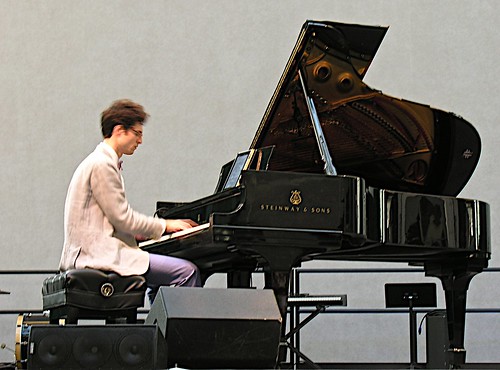 (Photo by Jon Hurd on flickr)
And of course, several of our composers have been incorporating technology and non-paper notation for years: Morton Subotnick and Alvin Singleton, for example.
Reading music from a screen, like reading a book from a screen, might not be for everyone, and of course we offer print-on-demand editions of all of our works. But for the adventurous, digital music is becoming an increasingly appealing solution.