 0 items in your cart
From Urgency to Art: Maria Vincenza Cabizza’s Operatic Debut Confronts Climate and Care
Oct. 18, 2025

On October 17, 89 Seconds to Midnight, a new opera composed by Maria Vincenza Cabizza and published by SZ Sugar was premiered at Teatro Farnese in Parma, Italy.
89 Seconds to Midnight is a dark, contemporary opera with an ancient atmosphere, a living entity, suspended in perpetual tension, yearning for a freedom that seems unattainable. Instrumental and electronic music, voice, theater, and dance converge to illuminate two urgent and highly contentious themes of our time: climate change and society’s treatment of its weak and vulnerable. In both, we identify a common element: the lack of care and the evasion of responsibility.
The title refers to the Doomsday Clock, a symbolic device created in 1947 by scientists from the Bulletin of the Atomic Scientists. Considering all the ways humanity could bring about its own destruction, from environmental collapse to nuclear and technological threats, it measures our proximity to apocalypse. Faced with the accelerating crisis, we find ourselves paralyzed, trapped between awareness and inaction, waiting for midnight to arrive. At the time of its creation it was set to 7 minutes and on January 2025 it reached 89 seconds: “in setting the Clock one second closer to midnight, the Science and Security Board sends a stark signal: Because the world is already perilously close to the precipice, a move of even a single second should be taken as an indication of extreme danger and an unmistakable warning that every second of delay in reversing course increases the probability of global disaster.”
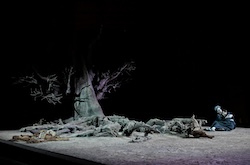
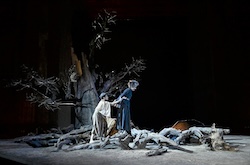
The opera unfolds in a desolate, arid landscape, the result of human negligence. A single dry tree, bent by wind and time, stands as a silent witness. The action takes place in a kind of dreamtime: it could be ancestral, or a future so distant it can no longer be named, inhabited by human-animals reminiscent of the Sardinian mamuthones.
89 Seconds to Midnight is both ritual and reflection, a meditation on the importance of care, whether toward people or the planet, a lesson whose value seems to fade in today’s society. The work depicts a journey toward death, undertaken by a mother (soprano) and son (countertenor) incapable of perceiving the beauty and fragility of the world around them, a metaphor for a self-referential civilization disconnected from emotion.
Their voices, like drops of water, intertwine in an intimate and obsessive dialogue. Near them, two shadows, the euphonium and tuba, rise from below, amplifying an inner fury until they almost dominate the soundscape: a whisper that repeats itself, an echo that does not dissolve, a constant call that fills every corner of the space. Each word, each phrase, becomes a drop falling into rhythm, creating a hypnotic pulse where voices merge, overlap, and chase one another in a fragile, almost sacred union.
Three magical presences, a dancer and the two before mentioned musicians, move within this rhythm, offering their bodies to the music and embodying the world in which the protagonists exist. The two musicians inhabit a dual role, blending music and gesture, serving as a bridge between these two realms. The electronics, meanwhile, manifest the oppressive environment the characters themselves have created, enclosing them in the sonic space of their own making.
The principal references that guided the libretto, written by Lisa Capaccioli, and artistic research include the Greek myth of Narcissus, The Ballad of Narayama by Fukazawa Shichirō, and Shakespeare’s Macbeth. The libretto is written in both Italian and English, and includes fragments from Shakespeare’s Sonnets.
Maria Vincenza Cabizza was born in Sassari (Italy) in 1991. She received numerous commissions from important institutions as Ensemble Intercontemporain, the MDI Ensemble, the Divertimento Ensemble, Le Centquatre Paris, the Gaudeamus Festival in Utrecht, the Impuls Festival in Graz and the Pontino Music Festival, Venice Biennale. In November 2022, she received the first prize at the Karol Szymanowski International Music Competition. Learn more about Maria Vincenza Cabizza here.
The cast of the première was:
Mother, Soprano Maria Eleonora Caminada
Figlio, Controtenore Danilo Pastore
Witch/Dancer, Daisy Ransom Phillips
Witch/Euphonium, Marina Boselli
Witch/Tuba, Fanny Meteier
Director, Lisa Capaccioli
Scene, costumes and video art Francesca Sgariboldi
Choreography, Daisy Ransom Phillips
Lights, Andrea Borelli
RIM and Sound Design, Davide Bardi
Production Photos (c) Roberto Ricci

News

Six works by Czech composer Miroslav Srnka were the principal focus of the 2017 DIALOGUES Festival in Salzburg, organized by …

The Saint Louis Symphony Orchestra led by David Robertson performs Sir Michael Tippett’s beloved oratorio A Child of Our Time …

The Orchestra Haydn di Bolzano e Trento and the Wiener Kammerchor, led by conductor Walter Kobéra performed the Italian …